

In this guide
- 01Who should hold a spare key and who should not
- 02Ways to hand over access, side by side
- 03How a house key copy is actually made
- 04Why a fresh copy sometimes will not turn
- 05Match the blank and check the copy against the original
- 06What “Do Not Duplicate” stamping does and does not do
- 07Restricted and patented keyways: why some copies need a card
- 08A simple key-control habit for the holidays
- 09When handing out keys means a rekey afterwards
- 10Where managed codes fit instead of more keys
- 11If a key fails or someone is locked out
- 12Rentals, townhomes and HOA doors in Austin
- 13Frequently asked questions
Give a spare house key only to a person you would trust with your front door, keep the number of copies small and written down, and make every copy from the original key, never from another copy. If a key you handed out does not come back, rekey the lock. That rule covers holiday guests, house sitters and pet sitters in Austin, and the rest of this guide explains why it works.
The holidays are when most households hand over keys. Relatives arrive, a neighbor feeds the cat, a sitter stays a week. Each handoff is small. Together they add up to a ring of copies that nobody has counted.
Who should hold a spare key and who should not
Give a copy to one or two people who can name the day it comes back: a close relative, a neighbor you know well, or one house sitter for a set stay. Skip a key for anyone who only visits once. Each extra copy is another key you must account for later, and you cannot account for a key you forgot you made.
Start with the question that matters: who needs to open this door when you are not there? A sitter feeding a pet needs a key for the length of the trip. A cousin staying for a weekend you are home for does not need one at all, because you can open the door.
Ask three questions before you hand anything over.
- Will this person need to enter when nobody is home?
- Can they tell you the day the key comes back?
- Would you be comfortable if they kept it by mistake?
If the answer to the third question is no, find another way. Meet them at the door, or use a managed code, covered below.
Keep the number of holders low, and keep it honest. A household with a spouse, one neighbor and one seasonal sitter has three holders. Write them down. The list is short on purpose, because a short list is one you will actually keep current.
Ways to hand over access, side by side
There are four common ways to give someone access to a keyed front door: a personal copy, a copy for a set stay, a key left with a neighbor, and a key left with a property manager. They differ in who controls the key, how you get it back and what can go wrong. The table compares the same three points for each.
Four ways to hand over a house key
| Option | Who controls it | How you get it back | Main risk |
|---|---|---|---|
| Personal copy for a trusted person | The holder | You ask for it, with no fixed date | It outlives the reason you gave it |
| Copy for a set stay | You, until the handoff | Return day agreed in advance | A copy made and forgotten |
| Key kept by a neighbor | The neighbor | Pick it up when you are home | Others in that home can reach it |
| Key held by a property manager | The manager's office | Request it from the office | You depend on their key log |
Read the table by the last column. The risk in every row is the same thing in a different costume: a key that nobody is tracking. The fixes are the same, too. Know how many copies exist, know who holds each one, and set a return day when you hand it over.
A personal copy suits a family member who will use the door often. A copy for a set stay suits a house sitter or pet sitter. Leaving a key with a neighbor works if that neighbor keeps it somewhere safe, and you should ask where. A property manager is common in rentals and townhomes. Their office may have its own rules about who can hold a key, so check before you plan around it.
None of these options is wrong. What fails is the version where a key is passed along without a note and without a date.
How a house key copy is actually made
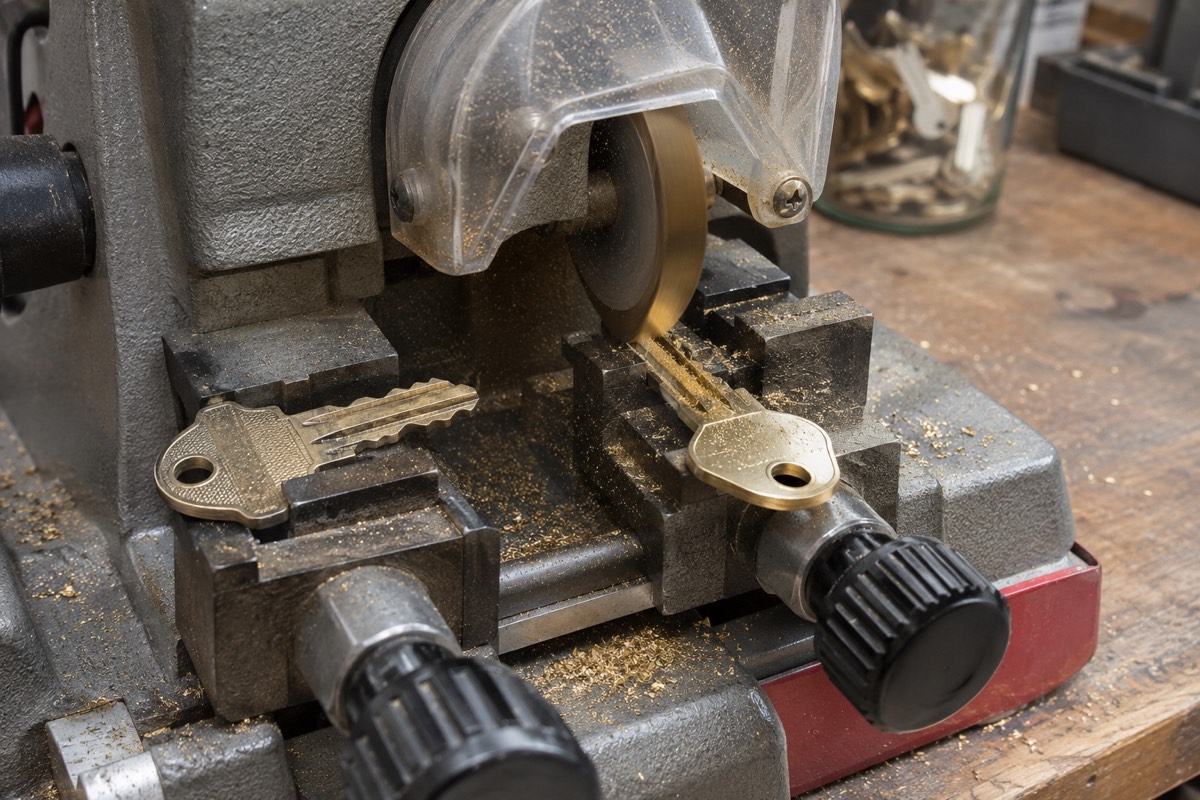
A key duplicating machine traces the original key in one vise while a cutter wheel shapes a matching blank in the other vise, following the original’s cuts. The copy can only be as accurate as the original key and the blank. Three terms help: the blank is the uncut key, the bitting is the pattern of cuts, and a cut is one notch.
Here is what happens at the counter. The blank clamps into one vise. The original clamps into the other. As the machine moves, a stylus follows the edge of the original while the cutter wheel removes brass from the blank in the same pattern.
Two things can go wrong before the cutter even starts. The blank might be the wrong shape for your lock’s keyway, which is the channel the key slides into. Or the original might be worn, so the stylus follows a surface that no longer matches how the key was first cut.
The machine does not know any of this. It copies whatever it is given. That is why the original matters so much, and why a copy of a copy can drift. Each generation can inherit the small errors of the one before it.
Why a fresh copy sometimes will not turn
A copy can fail to turn when its cuts differ slightly from the original or when the blank does not match the keyway. The pins in the lock then stop short of the shear line, and the plug cannot rotate. Schlage’s own rekey guide notes that duplicate keys wear faster and can carry cut differences that make a cylinder stick.
You do not need to know how a lock works to use a key. You do need one idea to understand why a copy fails. A pin tumbler lock holds a row of spring-loaded pin stacks in its cylinder. The right key lifts every stack until the split between its pins lines up on one invisible line, the shear line. When every split sits on that line, the plug turns. If one stack sits a little too high or a little too low, the plug stays put. For the full mechanics, our guide to how locks and keys work walks through the pins one at a time.
Now apply that to a copy. If one cut comes out too deep, the pin above it drops too far. The split ends up short of the line, and the lock refuses to turn. A copy that is off by a hair behaves just like a wrong key, because to the lock it is one.
Wear adds to the problem. Metal keys lose material with use, and a worn original can have cuts that no longer sit where they were first made. A copy cut from it can inherit the difference. Schlage’s guidance on duplicates is written about rekeying, so treat it as a reason to start from the original key, not as a rule about every copy ever made. Read the manufacturer’s note in Schlage’s rekey guide (PDF).
Hover or tap the lock below to try it. Pins whose split stops below the dashed line keep the plug from turning, and the slider shows how a worn original changes what the copy can do.
Match the blank and check the copy against the original
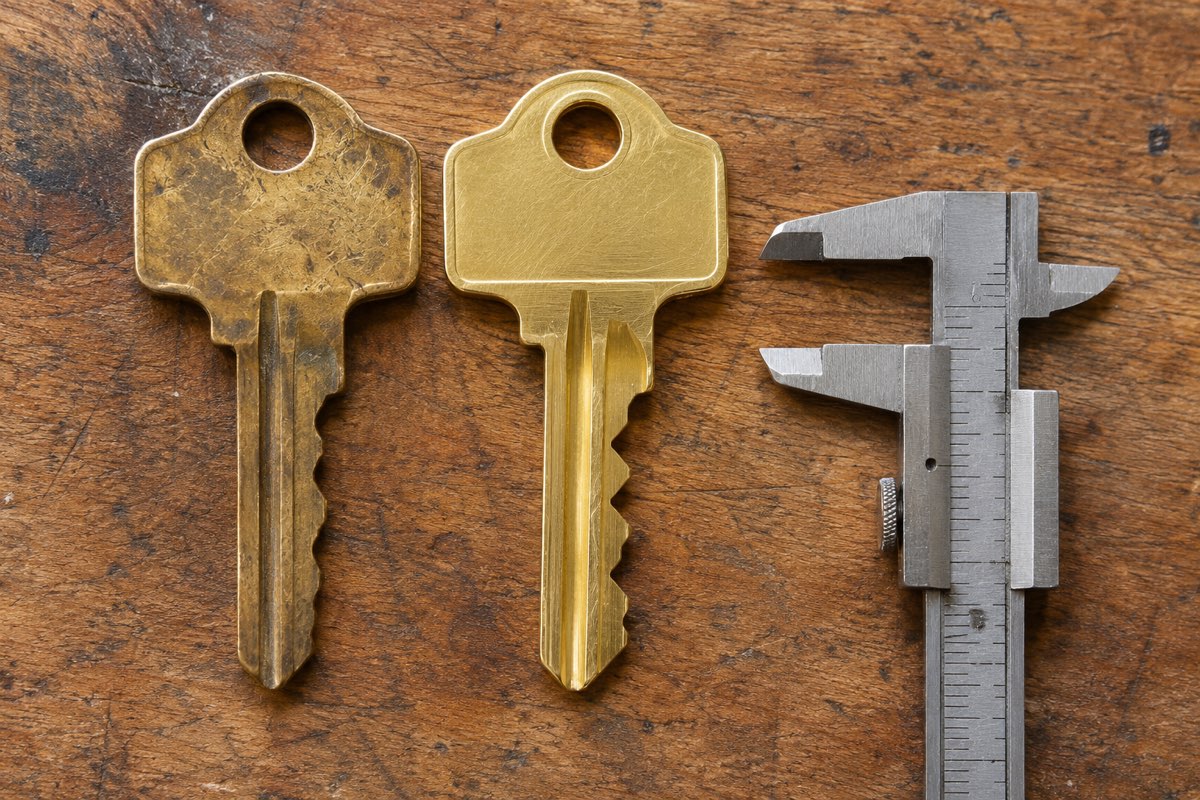
Choose the blank for the lock’s brand and keyway, not just the label stamped on the key. Kwikset states that only SC1 keys fit its SC1 SmartKey cylinder, and KW1 keys will not work in it. Then test each new copy in the lock before you hand it over, from the outside, with the door open.
Keyways are the part people overlook. Two keys can look alike, share a brand name and still be different keyways. The shape of the blank has to match the groove in the lock. Kwikset says this plainly in its support answer on whether KW1 keys work in the new SC1 cylinder, and the answer is no. Its rekey basics page names the KW1 keyway too.
That means “it is a Kwikset key” is not enough information. If you are not sure which keyway you have, bring the original and let the person cutting it read the key and the lock’s markings. Matching by brand name alone is how a wrong blank gets cut.
Then check the result. A copy that looks right can still be wrong by a small amount, and the only honest test is the lock itself. Stand outside, open the door, insert the copy, turn it and turn it back. Do it twice. Do it before the key leaves your hand.
A copy that sticks is a copy that will strand someone on your porch. Catching it at your own door costs one trip back. Catching it with a sitter outside costs a lot more.
What “Do Not Duplicate” stamping does and does not do
A Do Not Duplicate stamp is a request printed on the key, not a lock on the key blank. Standard keyways can usually be copied no matter what the key says. Real restrictions come from the keyway system and the dealer network behind it, not from the words stamped on the bow of the key.
Many people trust the stamp more than it deserves. It tells an honest shop to ask first, and some shops do. It does not change the metal. A common keyway uses blanks that are sold widely, so nothing physically stops a copy.
A stamp is a request. The keyway is the control.
Does that make the stamp useless? No. It is a reasonable signal that the key’s owner wants copies tracked. But if you are counting on it to protect you, you are counting on every shop reading it and every person at the counter caring. Treat it as a courtesy, and keep real control in your own hands: count your copies and know who holds them.
If you want key control built into the hardware, that is a different product with a different conversation. We cover it in our guide on whether a lock can really be pick proof. This guide stays on the practical side of handing out the keys you already have.
Restricted and patented keyways: why some copies need a card
Some key systems tie copies to an authorized dealer and a control card. Mul-T-Lock describes a key control card that lets its holder order extra keys, with cutting done at an authorized dealer. Medeco runs restricted lines that also expect identification. If your key belongs to one of these systems, ask before you plan a copy.
For a homeowner, the point is simple. These keys are not meant to be cut at a hardware store counter by a person who walks in with the original. The system is set up so the copy requires paperwork.
Here is how the card works, as Mul-T-Lock describes it in its MTL800 brochure (PDF). The card grants its holder the ability to order additional keys, and the original card goes to an authorized dealer who has the right cutting machine. Medeco describes a similar approach for restricted lines in its carded programs information. Details vary by product line, so confirm the rules for your own lock with the dealer.
What does this mean for the holidays? Plan earlier. If your key is restricted, a copy for a sitter may take longer than a walk-in cut, and the card holder has to be involved. Find your card, or find out who holds it, before the week you need the copy.
If you are unsure what kind of key you have, ask us. We can look at it and tell you whether a standard copy is realistic or whether the system will want a card.
A simple key-control habit for the holidays
A simple habit keeps every key accounted for: count the keys you have, label each copy with a code instead of an address, record who holds it and when it returns, hand it over in a plain envelope, and check it off when it comes back. The steps below turn that into a five-step routine you can repeat every time someone borrows a key.
The five-step key log
Count the keys you have
Lay out every key to the door, including spares in a drawer. You cannot track copies you have not counted.
Give each copy a code
Mark a copy with a letter or number, never your address or name. If it is lost, the finder learns nothing about where it belongs.
Write who holds which copy
Note the person, the code and the return day on paper or in a phone note. Two lines per key is enough.
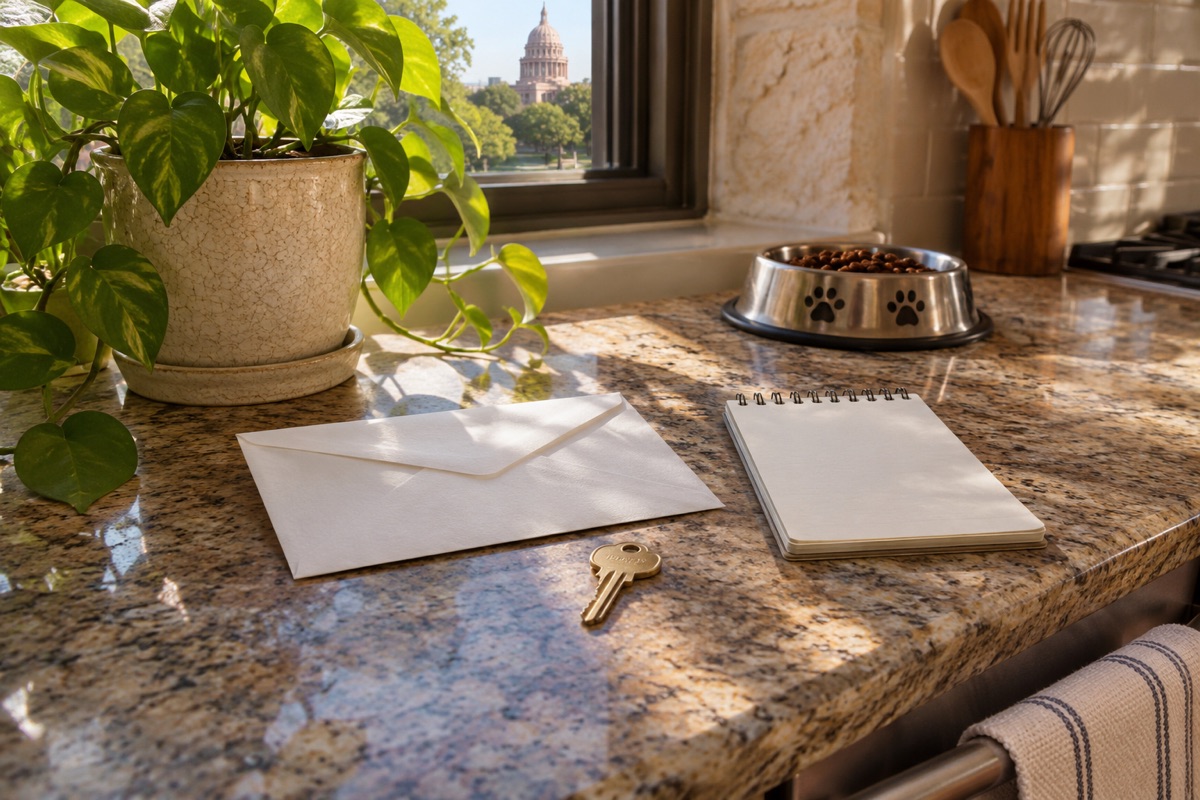
Hand it over in a plain envelope
Put the key in an unmarked envelope with the return date written inside. Do not attach a tag with your address.
Collect it, test it and cross the name off
When the key comes back, try it in the lock and update your list. A key that does not come back is the trigger for a rekey.
None of this takes long, and all of it pays off the first time a key goes missing. Without a list, you are guessing how many copies exist. With a list, you know exactly which one to chase.
One more point about labels. It feels natural to tag a key with your street address so it can be returned if lost. Do not. A key with an address attached is a key that tells a stranger which door to try.
When handing out keys means a rekey afterwards
Rekey when a key you gave out is lost, unreturned or held by someone who should no longer have it. Kwikset frames it the same way: the person who has your key today may not be the person you want to have it tomorrow. A rekey changes the cylinder so the old key stops working.
Notice what that rule does not say. It does not say rekey after every visit. A sitter who returned the only copy on the day you agreed, and you tested it, has given you no reason to change anything.
The trigger is a gap in the key’s story. Maybe a copy never came back. Maybe a sitter mentioned making an extra “just in case”. Maybe a roommate moved out, a relationship ended or a contractor kept a key longer than the job. In each case you no longer know where one key is, and a lock that opens for an unknown key is a lock you cannot rely on.
Rekeying keeps your existing hardware and changes how the cylinder responds. Kwikset explains on its SmartKey page that after rekeying, the old key no longer operates the lock, and it describes lost or unreturned keys becoming obsolete. Our pages on lock rekeying and lock rekey in Austin cover how a locksmith does it.
If you are rekeying because you just bought the home, the guide to rekeying locks after moving in has that case. If a key is simply missing and you are not sure what to do next, read what to do if you lose your keys.
Where managed codes fit instead of more keys
A managed code can replace a spare key for a sitter on a compatible smart lock, because the code can be set to work always, on a recurring schedule or for a set window. A code does not replace your keys, and it only helps if you remove it when the stay ends.
Schlage describes this on its own page about smart locks for time away: the owner can create a unique access code for a house, plant or pet sitter in the Schlage Home app, so there is no physical key to track. Guest codes can be set as always, recurring or temporary, with a start and end time, and can time out automatically. Support varies by model, so check that your lock is compatible. Read Schlage’s note on sitter codes for the details.
A code you forget to remove is as open as a key you forget to collect.
Think of a code as one option, not a replacement for good key habits. You still have physical keys, and those still need counting. A code adds a new thing to manage, because a code that stays active after the stay ends gives access just as an uncollected key does.
Does it fit your situation? If a sitter visits several times a year, a recurring code saves repeated handoffs. If you have a single holiday trip and a trusted neighbor, a key in an envelope may be simpler. Pick the one you will actually keep track of.
If you want a keypad or smart lock installed, see our page on smart lock installation.
If a key fails or someone is locked out
If a key will not turn, first check that the right key is in the right lock and that the door is not pushing against the bolt. Then stop forcing it. A bent key or a broken tip makes the problem harder to fix. If it still will not turn, call with the address and what happened.
Run through a short list before you call.
- Is it the right key? Copies of similar keys get mixed up, especially in an envelope with other keys.
- Is the key fully inserted? Pull it out a hair and try again.
- Is the door under load? Pressing the door toward the frame, or lifting the handle, can free a stuck bolt.
- Does the original work? If the original turns and the copy does not, the copy is the problem.
If a sitter is locked out and the original is with you, the simplest fix is often to bring the original over, if that is realistic. If it is not, or if the lock itself feels wrong, call us at (512) 777-0021 with the address, and tell us what the key and the lock are doing.
Do not pull, hammer or spray the lock. Each of those can turn a stuck key into a damaged cylinder. For a longer walk-through, our guide on what to do when you are locked out of your house covers the steps in order, and our home lockout service page explains what a visit involves.
One more tip: tell your sitter in advance what to do if the key does not work. A sentence in the note, such as “if it will not turn, do not force it, call this number”, saves a bad evening.
Rentals, townhomes and HOA doors in Austin
Many Austin rentals, townhomes and apartments use a key system that the landlord or the association controls, so check the lease or the community rules before you copy or rekey anything. Rules differ by property. A change you are free to make in a home you own may breach an agreement in one you rent.
Why does this matter for spare keys? A landlord may restrict who can hold keys, require a copy to be left with the office or ask to approve any lock change. An HOA may use a master system or its own entry hardware on shared doors. Copying a key from a restricted system, or rekeying a lock the association manages, can create a conflict you do not want in the middle of the holidays.
So start with the paperwork. Read the lease. Ask the property manager what is allowed, who keeps a spare, and whether a sitter can be given a key. Ask in writing if you can, so you have a record.
If you own the door and the rules are yours to set, everything above applies directly. If someone else owns the door, their rules come first. Our residential locksmith services page lists what we handle at the home, and a quick call with your situation will tell you whether it is something we can do or something to take to your landlord first.
Frequently asked questions
How many spare keys should I give out?
As few as the household really needs, usually one or two holders in total. Write down who has each copy and the day it comes back. Every extra copy is one more key to account for, and a key nobody can place is the usual reason a lock gets rekeyed.
Can a locksmith copy a key marked Do Not Duplicate?
It depends on the keyway. The stamp is a request printed on the key, not a lock on the key blank. Standard keyways can often be copied anyway. Restricted systems tie copies to an authorized dealer and a control card, so ask before you bring the key in.
Why will my new copy not turn in the lock?
The cuts may differ slightly from the original, the blank may not match the keyway, or the original may be worn. Pins then stop short of the shear line and the plug cannot rotate. Try the original, then bring both keys back so the copy can be checked or recut.
Do I need to rekey after a house sitter returns the key?
Not if the key came back and was the only copy they held. Rekey if a key is lost, not returned, or may have been copied, or if the person should no longer have access. A rekey changes the cylinder so the old key stops working.
Is a smart lock code safer than a spare key for a sitter?
It is a different trade, not a ranking. On compatible models a code can be always on, recurring or temporary, and you can remove it after the stay. A code does not replace your keys, and it only helps if you actually delete it when the visit ends.
Where should I not hide a spare key?
Outside the home. The Texas Department of Insurance advises against leaving a key outside. Under a mat, in a planter or on a ledge, a hidden key works for anyone who looks. Give the key to a person you trust instead.
If you have a key question before the holidays, call 512 Locksmith at (512) 777-0021 with the key type and your address, and we will tell you what is realistic.