

In this guide
- 01Which locks did that one key ring open?
- 02What a rekey changes inside the cylinder, and what it leaves alone
- 03The suite door: rekey it, then check who controls it
- 04The back or side door, and keys that are keyed alike
- 05Interior offices and storage rooms
- 06Interchangeable cores: changing the core without opening the lock
- 07The small locks nobody lists: cabinets, desks, mailboxes and padlocks
- 08Key cabinets, lockboxes and safes: when the lock is a combination
- 09What a key never opened but still needs changing
- 10What the building controls: check the lease first
- 11Doors that must still let people out
- 12What to have ready before you call, and what to ask any locksmith
- 13Frequently asked questions about rekeying office locks
- 14Rekeying office locks in Austin? Call 512 Locksmith
When one person leaves, rekeying a lock changes the pins inside its cylinder, so the old key stops working in that lock and a new key takes over. Each lock is done on its own, and a rekey cannot change a code, a combination or a lock the building controls.
This guide goes lock by lock through a small keyed office in Austin, from the suite door to the file cabinet. The process side of staff changes is covered in our commercial guide.
Which locks did that one key ring open?
Start with the keys, not the doors. List every lock the departing person’s keys opened: the suite door, a back or side door, any private office or storage room, and the small locks on cabinets, desks, mailboxes and key boxes. Each lock then lands in one of three groups: rekey it, replace its plug or core, or change a code or ask the building.
The diagram below traces one key ring through a small office floor plan. A circle marks a lock to rekey. A square marks a lock that may need a replacement plug or core. A diamond marks a lock where the fix is a code or a call to the building. The squares depend on the model, so check what each desk or file lock takes. The suite door carries a circle and a diamond: rekey it, and check who controls it first.
Not every lock on the plan belongs on every list. A lock the departing person’s keys never opened needs nothing from a rekey. Write down what the ring opened first, then sort.
What a rekey changes inside the cylinder, and what it leaves alone
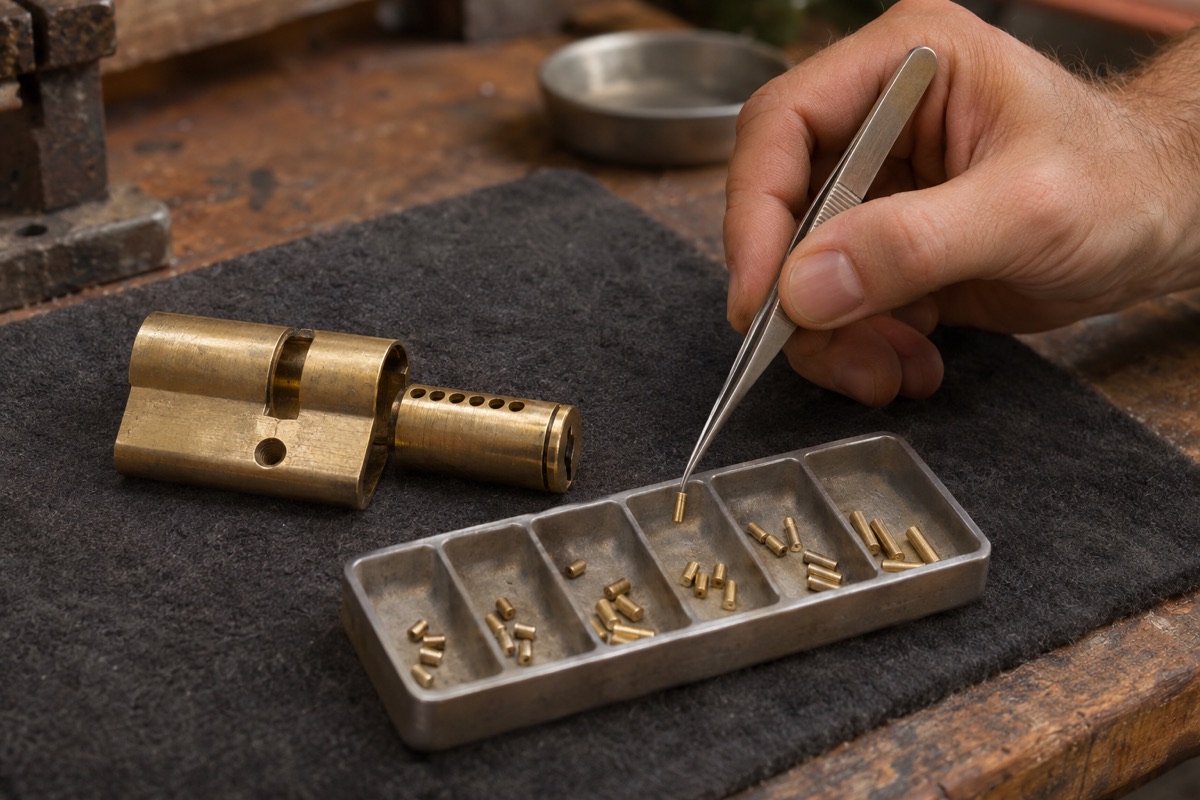
A rekey swaps the pins inside a cylinder so a new key lines them up at the shear line and the old key no longer does. The lock body, the latch and the door stay as they are, and any lock that was not repinned keeps its old key. A conventional cylinder generally needs some disassembly while it is worked on.
In a pin tumbler cylinder, each cut of the key lifts a pair of pins. Schlage’s rekey guide defines the shear line as the point where the top of the plug meets the inside of the shell. The bottom pins must be raised to that height for the plug to turn. Rekeying means repinning: different bottom pins are fitted so a new key lines every pin up.
The full mechanics are in how locks work, and our lock rekey service page covers the work itself. A worn copy of a key is a different weak point, and the spare keys guide covers that one.
Hover or tap to slide the old key in, then drag Pins changed to the left to see the same lock before the rekey.
The drawing is simplified: five pins, one key, no master pins and no springs shown. With the slider at the left, the plug holds the pins the key was cut for, and every split between pins lands on the dashed shear line, so the plug turns. As the slider moves right, the lower pins are swapped. The same key now leaves some splits high and some low, and the plug cannot turn. That is what a rekey does to an old key.
Schlage’s Advanced Rekey page puts the result in one line: “Once rekeyed, your old key will no longer work.” Some locks are built so the owner can rekey them. Kwikset’s SmartKey and Schlage’s Advanced Rekey are two examples, and both need the current working key and a tool. Schlage’s is a residential product, so do not assume an office lock has either one.
The suite door: rekey it, then check who controls it
The suite door is the first lock to check. If the departing person’s key opened it, its cylinder is repinned or its core is changed, and the old key stops working. Whether a tenant may change it at all can depend on the lease, so read the lease first. Decide how many new keys it needs before the work starts.
A rekey leaves the door, the latch and the hardware where they are. A worn or damaged door or set of hardware is a separate job, and our commercial door services page covers that side. For the rekey itself, see commercial lock rekeying.
Keys are the other half of the job. After a rekey only the new key works in that lock, so everyone who still needs the door needs a new key. Count the keys before the work starts. Say how many the suite door needs when you call, and count everyone besides the departing person who holds a key.
The back or side door, and keys that are keyed alike
A back or side door with a keyhole is rekeyed like any other door: its cylinder is repinned so the old key stops working. The choice that matters is whether it should share a key with the suite door. Keyed alike means several locks open with one key, and keyed different means each lock has its own. Decide before the work, because each lock is repinned on its own.
Keyed alike means fewer keys to carry. Keyed different means the key for the back door does not open the front. Either is a fair choice, and the call is yours, so tell the locksmith which you want for each pair of doors.
If your lock belongs to a master key system, where one key opens many locks, say so on the call: Schlage’s commercial pages say a lost master or perimeter door key can force a partial or complete rekey of the building.
Interior offices and storage rooms
Interior doors matter only if the departing person’s key opened them. A private office or storage room with a keyhole has a cylinder like any other and is repinned the same way. A door with no keyhole has nothing to rekey. If an interior door should share the suite key, say so before the work.
The door function is a separate question from the lock, and the guide on which lock goes on which door names each function, though it is written for homes.
Interchangeable cores: changing the core without opening the lock
An interchangeable core is a cylinder built to come out of the lock with a special control key, without taking the lock apart. Schlage says these cores allow cylinder rekey or replacement without disassembly of the lock. They help only where the door already has that hardware, because a core does not drop into a standard lock.
Schlage’s full size core page says a special control key lets the cylinder come out of the lock without disassembly. Full size cores are specific to the lock maker’s design, and small format cores follow an industry standard plug size.
Interchangeable cores allow cylinder rekey or replacement without disassembly of the lock.
If you think a door has one, our interchangeable core locks page explains what the hardware is. A photo of the lock face helps a locksmith tell whether yours does.
The small locks nobody lists: cabinets, desks, mailboxes and padlocks
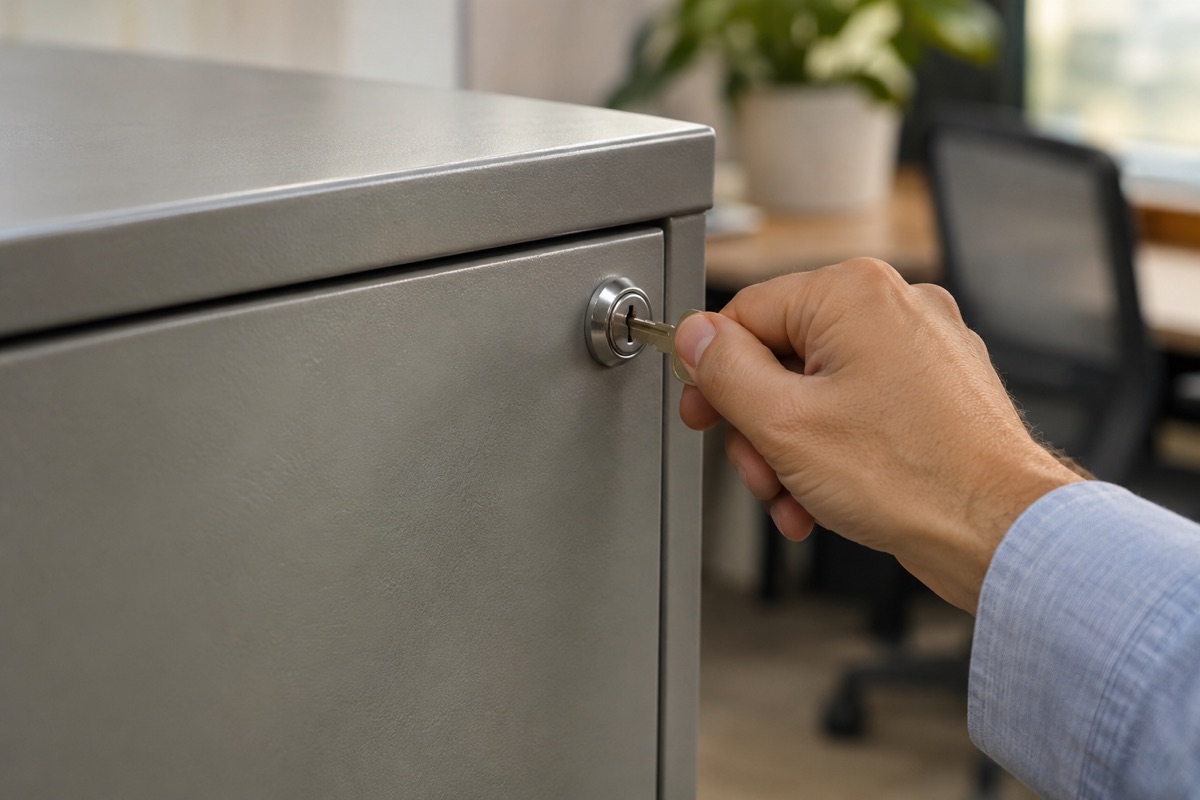
File cabinets, desks, mailboxes and padlocks each have their own key and are easy to leave off the list. A rekey on the doors does not touch them. Some desk and file locks are made as replaceable plugs, some padlocks rekey or take a new core, and a mailbox may belong to the building or the Post Office.
Some desk and file cabinet locks are sold as replacement plugs with the key code stamped on the lock face. Some cabinets have a removable core that lets the owner change the key code, and some plugs rekey with a service kit. So the fix may be a new plug or core and not a rekey, which depends on the model. A parts catalog or a locksmith can tell you which applies.
A mailbox is a question of who owns it. For a postal-owned cluster box, the Post Office provides the lock and keys and keeps no duplicate keys. For a private or building-owned mailbox, ask the owner or manager. Our mailbox lock guide walks through ownership.
Padlocks vary. Kwikset sells padlocks you can rekey yourself with the working key, and Master Lock describes padlocks with an interchangeable core. Whether yours can be rekeyed depends on the model, so ask the maker or a locksmith.
Key cabinets, lockboxes and safes: when the lock is a combination
A wall key cabinet, lockbox or safe may open with a combination, and a rekey cannot reach a combination. Many lockboxes let the owner set a new code using the box’s own instructions. Some safes allow it and some do not, so the model’s manual decides.
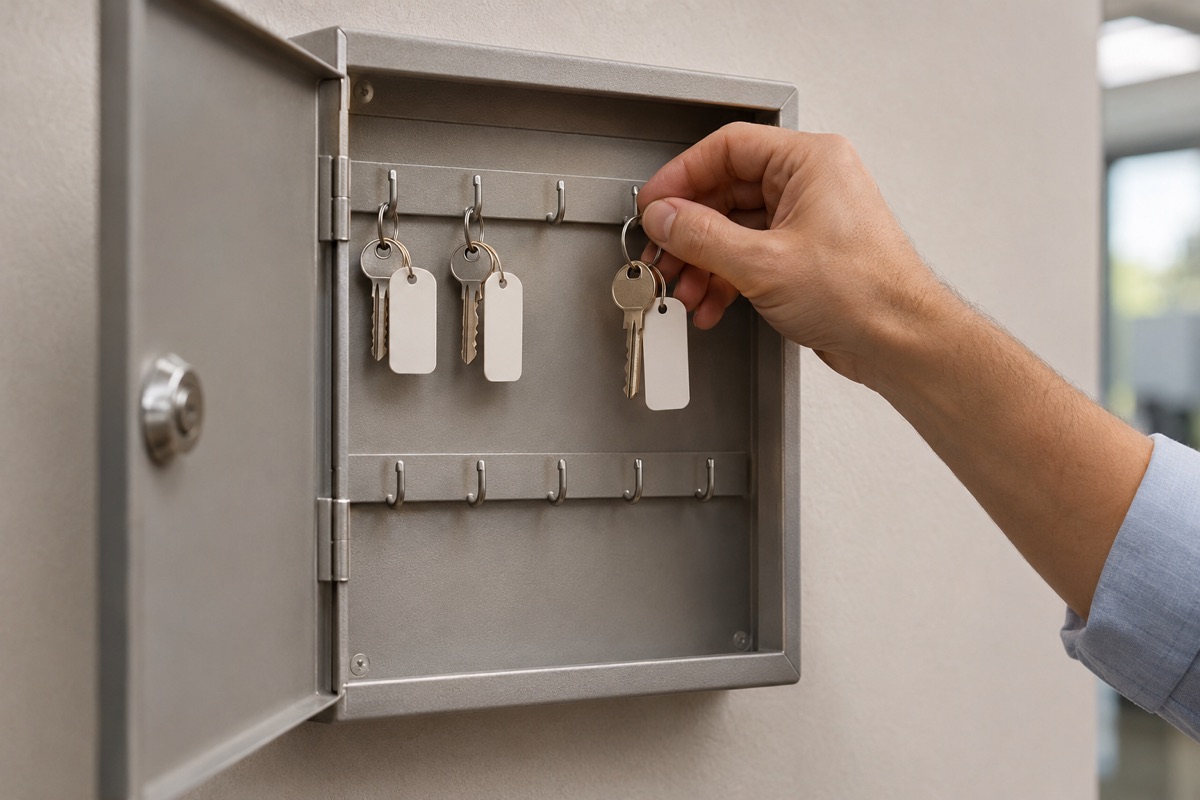
A wall key cabinet has its own key or code, so it goes on the list too. If it opens with a key, whether that small lock can be rekeyed depends on the model, so ask the maker or a locksmith. If it opens with a code, the box’s own instructions say how to set a new one, and the manual is where to look.
One safe maker shows how much models differ. SentrySafe’s owner’s manual for one fire-safe family says the combination cannot be changed on its mechanical dial models. On its electronic models the owner can add and delete codes, but the factory code stays. Look up your own model’s manual before you assume either.
Lock by lock: what a rekey does. Cells marked depends vary by model.
| Lock | Can it be rekeyed | What changes instead | Who controls it |
|---|---|---|---|
| Suite door | Yes, repinned to a new key | Core swapped if it has an interchangeable core | Check the lease |
| Back or side door | Yes | Matched to the suite key only if keyed alike | Check the lease |
| Interior office or storage room | Yes, if it has a keyhole | Shares a key only if keyed alike | Check the lease |
| Door with interchangeable core | Core changed with a control key | No lock disassembly | Check the lease |
| Desk drawer | Some models | Replacement plug or service kit, depends on the model | Whoever owns it |
| File cabinet | Some models | Replacement plug or removable core on some cabinets | Whoever owns it |
| Mailbox | Not by the tenant if postal-owned | Ask the Post Office about a new lock, or ask the owner or manager for a private box | Post Office or building owner |
| Padlock | Some models | New core or a new padlock, ask the maker | Whoever owns it |
| Key cabinet or lockbox | Not if it opens by combination | New code from the box's own instructions, depends on the model | Whoever owns it |
| Safe | Depends on the model | New user code on some electronic models, some dial combinations cannot be changed | Whoever owns it |
What a key never opened but still needs changing
A key only ever opened locks with a keyhole, so the rest of the list needs other steps. A keypad code is changed at the lock, a garage opener may need its memory erased and every remote you keep reprogrammed, and an alarm code follows the alarm provider’s steps.
- Keypad code. Schlage’s keypad lock guide describes a programming code and user codes, with steps to delete one or all user codes. The steps depend on the model.
- Garage or gate remote. Chamberlain’s support site says erasing an opener’s memory deletes all previous codes, and each remote or keypad you keep must be reprogrammed. That applies to openers with a learn button, not every gate.
- Combination or box code. Set a new one using the box’s own instructions, as covered above.
- Alarm code. Ask the alarm provider how to change it.
The same departure also touches shared codes, account ownership and who holds what, and our commercial guide covers that process side.
What the building controls: check the lease first
Texas Property Code Chapter 93 covers commercial tenancies, and it says nothing about whether a tenant may change the suite lock. The lease decides, so check it or ask the building manager before anyone touches the suite door. One section, 93.002, says a lease supersedes that section where the two conflict.
Where the chapter mentions locks, it speaks to what a landlord may do. Section 93.002 limits when a landlord may remove a door or lock, and when a landlord may keep a tenant out. Locks and keys come up only in that section and the one after it. So the chapter says nothing on keys at lease end, or on whether a landlord keeps a key. This is a reading of Chapter 93 alone and is not legal advice. Read the chapter yourself.
A rekey on the doors does not reach the lease. Read it before anyone touches the suite door.
Our property management rekeying page covers the building side of this work.
Doors that must still let people out
A rekey changes pins and keys, not how a door works from the inside, so it should never turn an exit door into one that needs a key to leave. The Texas State Fire Marshal’s Office says businesses must have unlocked exit doors with clear paths to them. Check the codes your city has adopted.
That line is from a plain language safety post from the Texas Department of Insurance, not from the code itself. The City of Austin lists the International Building Code and International Fire Code at the 2024 editions, with local amendments effective July 10, 2025. Ask the City or your building manager what those codes require for your door.
Schlage’s commercial catalog cautions that double cylinder locks on doors used for egress are a life safety hazard and are not recommended. Schlage’s commercial ND series cut sheet lists the inside lever as always free for egress on its passage, exit and privacy functions. If a lock change would put a keyhole on the inside of an exit door, stop and ask first.
What to have ready before you call, and what to ask any locksmith
Have a short list ready: every lock the keys opened, how many new keys each needs, which locks should be keyed alike, and who controls the suite door. Then ask any locksmith for a Texas DPS license number. Texas licenses locksmith companies through the Department of Public Safety under Occupations Code Chapter 1702. Ours is B07298601.
Put these questions to anyone you call:
- Which of my locks can you rekey, and which need a new plug, core or code?
- How many keys does each lock get, and which locks are keyed alike?
- Will you test the new key in every lock, and the old key too?
- What is your Texas DPS license number?
If you are locked out instead of rekeying, the guide on office lockouts during business hours is the better place to start. To talk through your own list, call (512) 777-0021.
The day, in order
List the locks
Every lock the keys opened, cabinets and padlocks too.
Check the lease
May you change the suite lock, and does the building hold a key?
Decide on keys
How many per lock, and which locks share one.
Call with the list
Describe each lock and photograph each lock face.
Test every lock
The new key turns it and the old key does not.
Change the rest
Keypad codes, remotes, combinations and the alarm code.
Frequently asked questions about rekeying office locks
Does rekeying a lock stop the old key from working?
Yes, for the cylinder that was rekeyed. Rekeying swaps the pins so a new key lines up at the shear line, and Schlage says the old key will no longer work once a lock is rekeyed. A lock that was not repinned keeps its old key, so each lock on your list needs its own rekey.
Which office locks can be rekeyed and which cannot?
A door cylinder with a keyhole can be rekeyed. Some desk, file and padlock models can be rekeyed or take a new plug or core, depending on the model. A combination or a code cannot be rekeyed, and the lock on a postal-owned mailbox belongs to the Post Office.
Do I have to rekey every lock when one employee leaves?
No. A rekey is only for the locks their keys opened, and a lock the keys never opened needs nothing from a rekey. List what was on the ring, then decide lock by lock: rekey it, replace its plug or core, or change a code. Locks keyed alike share one key, so check which ones the ring covered.
Can I rekey the suite door if I rent my office?
Texas Property Code Chapter 93 covers commercial tenancies but does not address whether a tenant may change the suite lock. Your lease decides, so read it and ask the building manager, ideally in writing, before any work starts. This guide is not legal advice.
What is an interchangeable core, and does my office door have one?
An interchangeable core is a cylinder that comes out of the lock with a special control key, with no lock disassembly. It helps only where that hardware is already installed. Photograph the lock face and any model name stamped on it, then ask the locksmith to check.
What should I ask a locksmith before they start work?
Ask for the Texas DPS license number, which locks are in scope, how many keys each needs, whether any locks should be keyed alike, and whether the old keys will be tested in each lock afterward. Our license number is B07298601.
Rekeying office locks in Austin? Call 512 Locksmith
Describe the doors, cabinets and boxes on your list, and we will say which can be rekeyed and which need another fix. Texas DPS license B07298601. Serving Austin since 2012. Call (512) 777-0021, or read about our commercial locksmith services.