

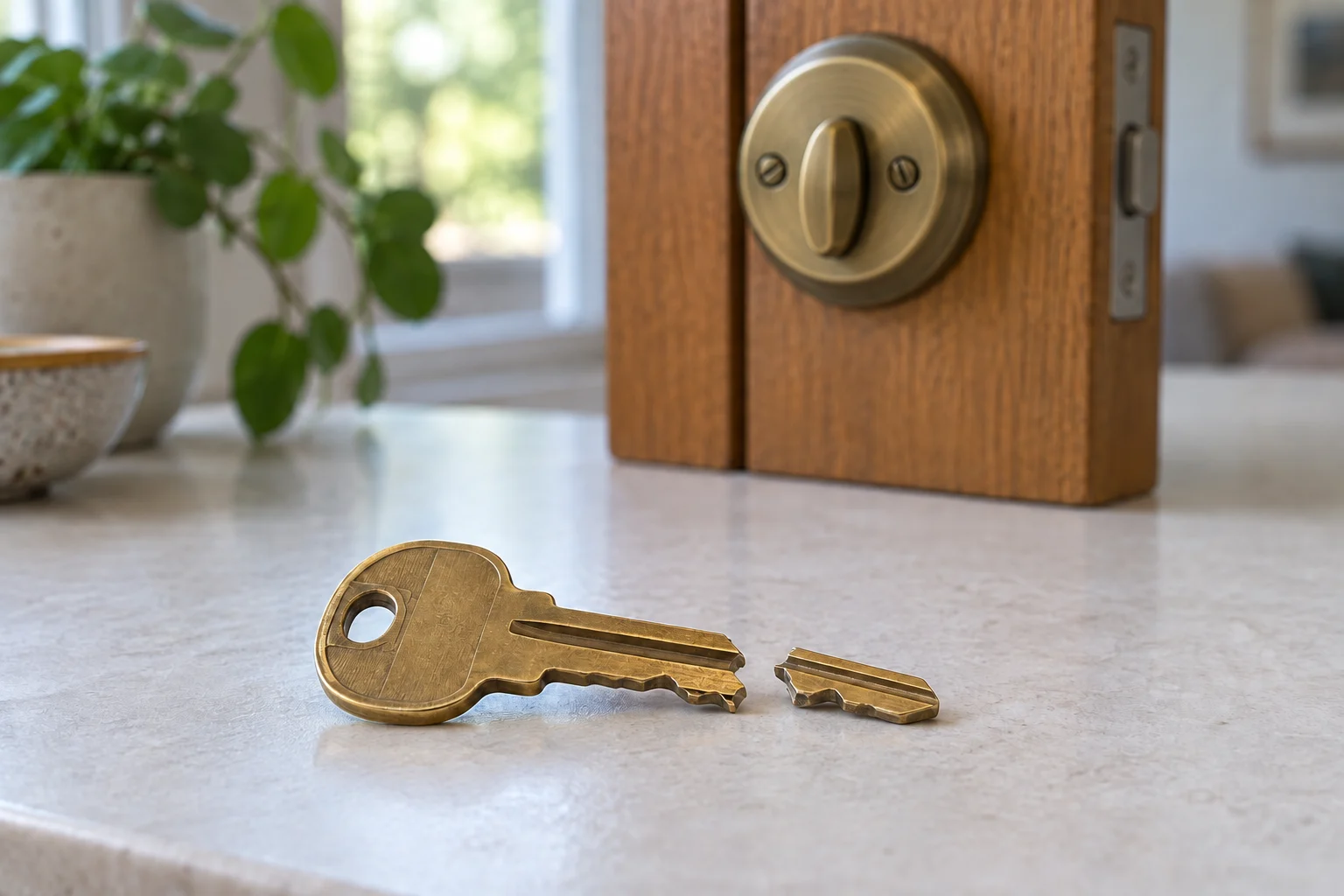
If your key snaps, stop turning it and keep the part in your hand. Pushing another key into the lock can move the broken piece farther inside. If the door is open, leave it open until you know you can secure it without trapping yourself outside.
In this guide
Why keys break inside locks
A worn, bent or cracked key can fail under turning force. Dropping your keys, carrying heavy keychains, or using a key to pry open boxes creates micro-fractures in the blade.
The condition of the lock also plays a role. When internal pins lack lubrication or the door is misaligned, you have to apply more force to turn the plug. This twisting pressure eventually causes a weakened key to shear off. Repeated difficulty turning the key is a reason to inspect the lock before the blade breaks.
Initial steps when a key snaps
Your immediate response can determine whether the lock survives. Do not try to push the broken piece deeper into the keyway. Attempting to turn the remaining fragment with a screwdriver or pliers often damages the delicate pins inside the cylinder.
You should also avoid applying superglue to the broken head in an attempt to reattach it. Glue can enter the cylinder and turn an extraction problem into a damaged lock. Do not insert random objects like paperclips, saw blades, or wire into the keyway. These items can push the fragment completely out of reach or scratch the internal components.
If a significant portion of the key is protruding from the face of the lock, you might be able to grip it with thin needle-nose pliers and pull it straight out without twisting. If the fragment is flush with or inside the keyway, stop and evaluate the situation.
When a key breaks in a lock
A piece can remain inside the lock after the key head breaks away.
- Key head
- Fragment
- Stop point
Further reading: Schlage Commercial: Schlage Everest 29 SL service manual
Broken house key at a door
How a broken key is extracted
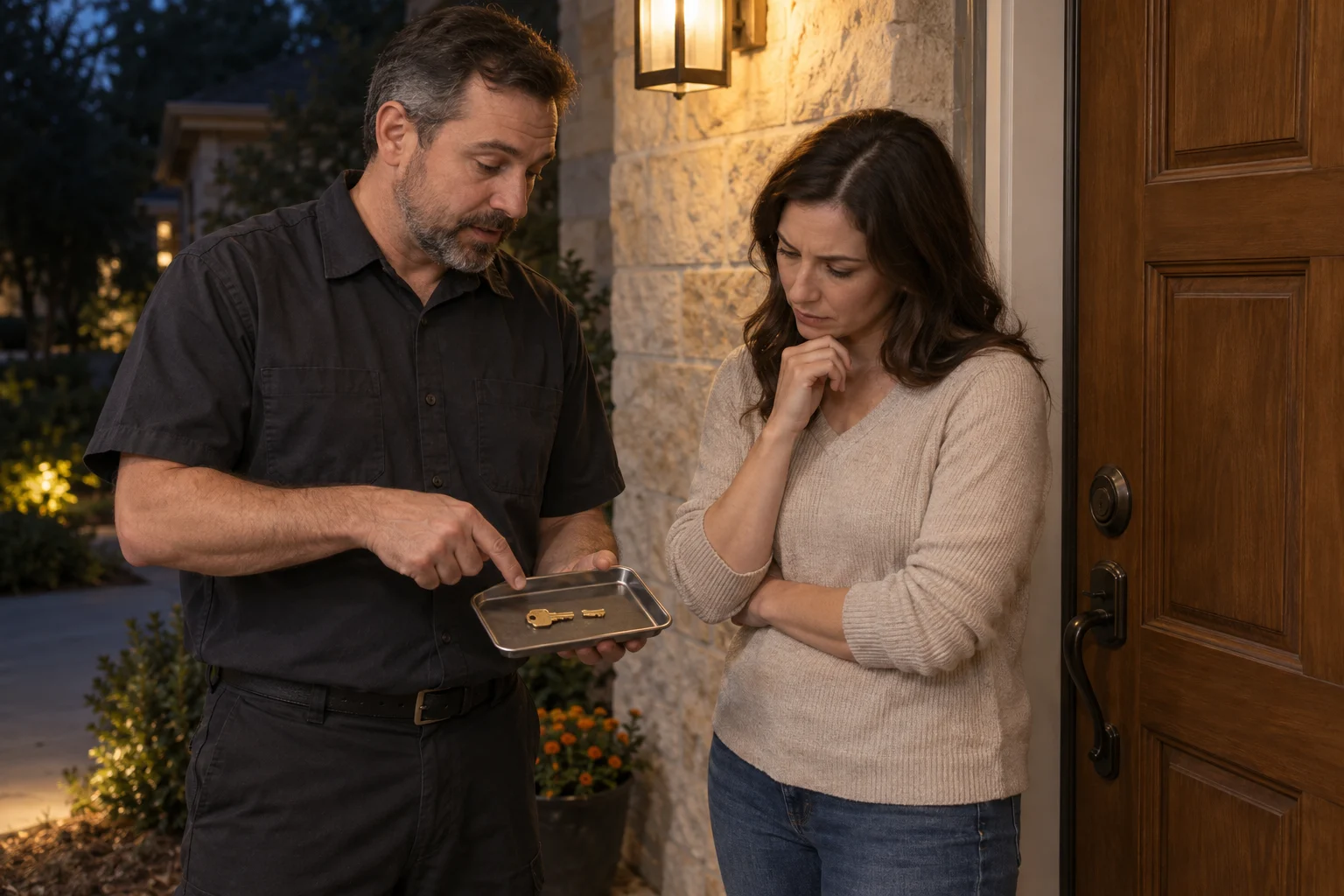
When you request key extraction services, a technician will evaluate the type of lock and the depth of the fragment. They use specialized spiral extractors and hooked extraction tools designed to slide alongside the broken blade without catching the lock pins. These tools grip the cuts of the key to pull it outward.
If the lock is heavily worn or the fragment is wedged tightly, the technician may need to disassemble the lock cylinder to push the piece out from the back. Once the fragment is removed, they will test the cylinder to confirm no pins or springs were damaged during the break.
Broken keys in vehicle ignitions
Car ignitions present a more complex problem than standard door locks. The mechanical ignition cylinder and the electrical switch perform different jobs, even when they are part of a connected assembly. Attempting to remove a broken key from an ignition often damages the switch housing or the steering column lock.
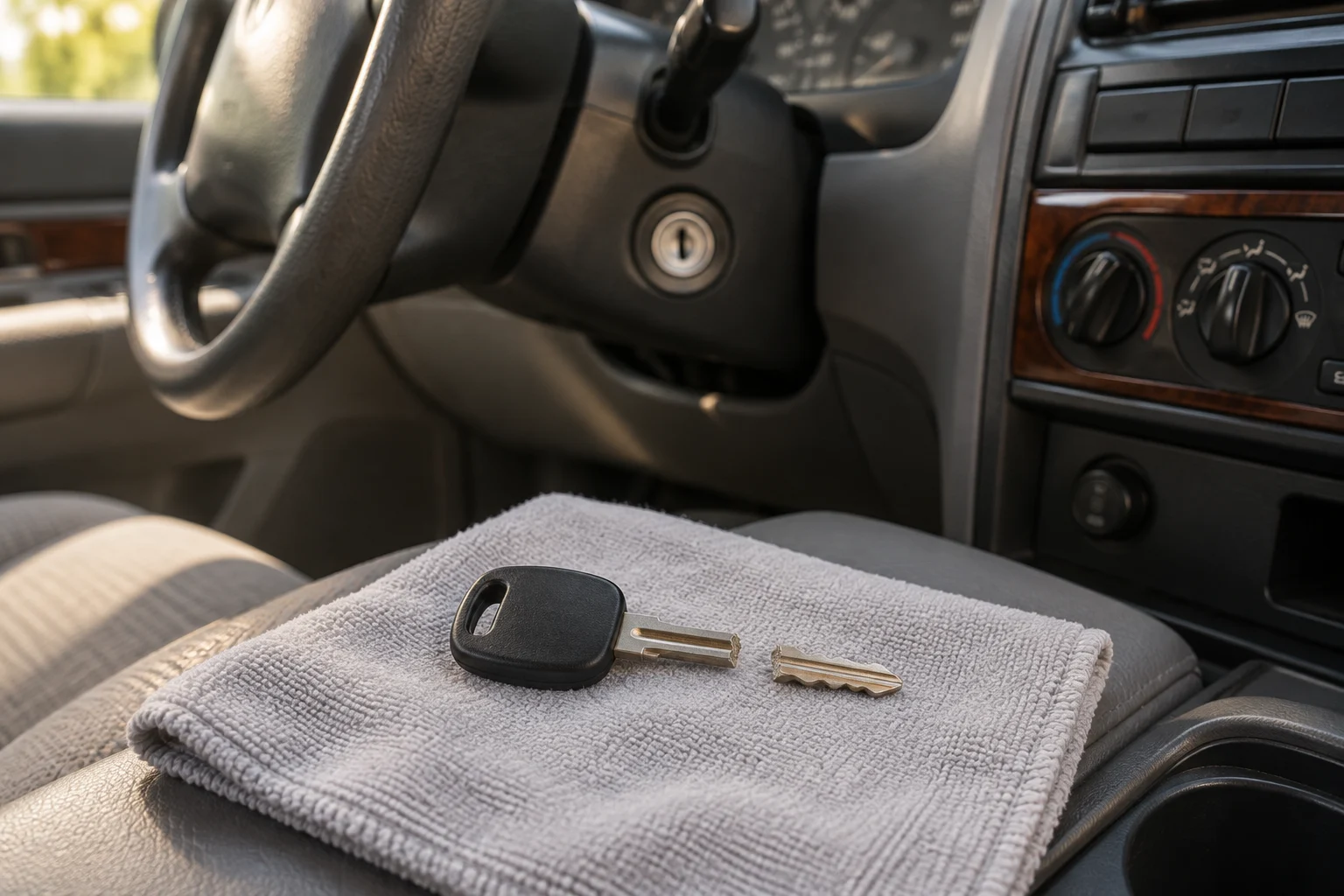
Modern car keys also contain transponder chips. A blade break does not necessarily damage the chip in the key head. Keep the head and fragments for the technician, who can check which parts are usable. An automotive locksmith will evaluate whether the ignition cylinder needs to be removed for extraction. Ask whether the provider supports your make, model and year, and whether a new blade, a complete key or programming is required.
Broken ignition blade
Check why it broke before using another key
Removing the fragment is only part of the job. If the door has dropped on its hinges or the bolt scrapes the strike, a fresh key may meet the same resistance. Ask the technician to test the hardware with the door open and closed and explain any additional repair before you authorize it.
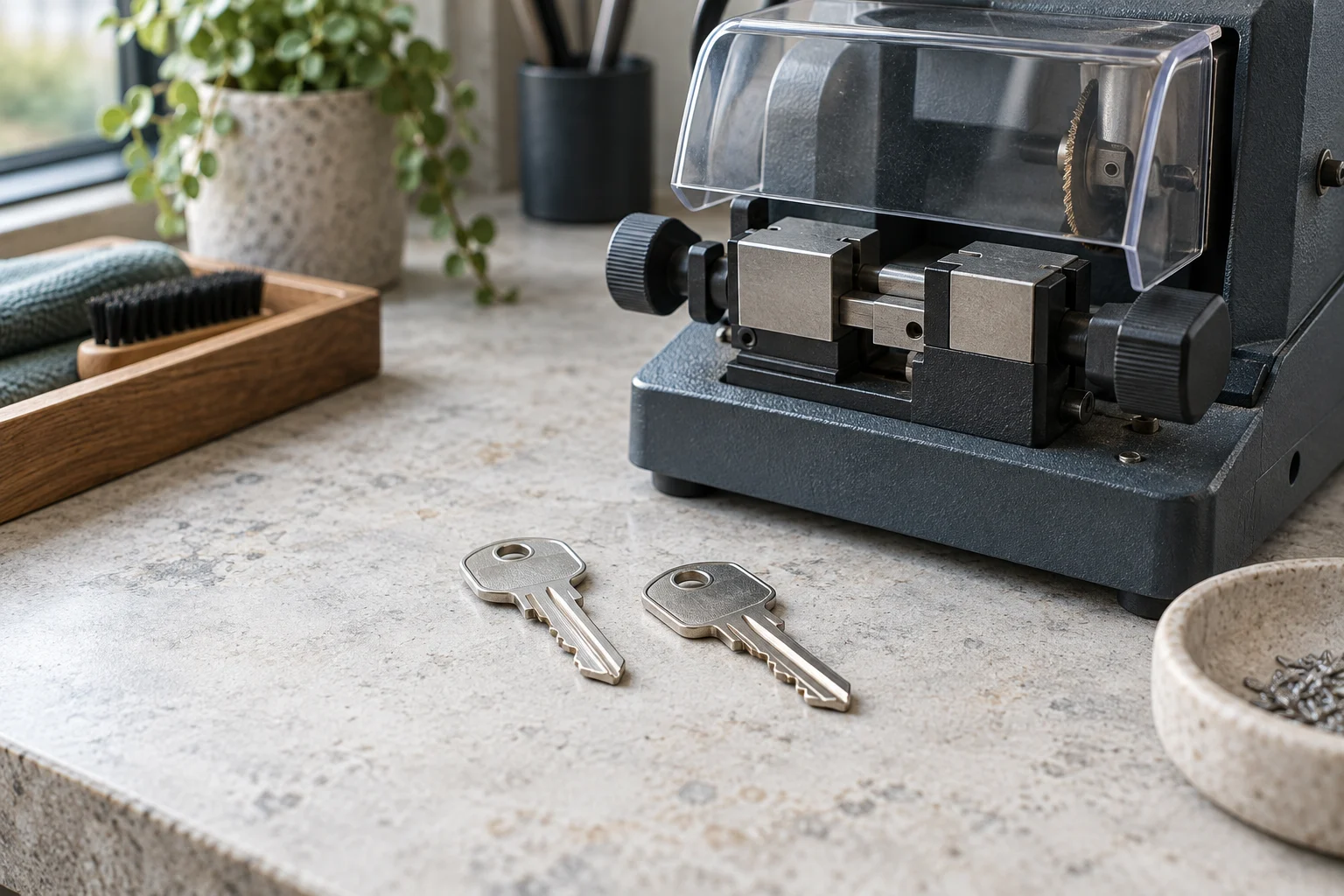
A copy made from a badly worn key may reproduce the wear. Bring a sound spare if you have one, and ask what the replacement will be cut from. Keep both broken pieces until the new key has been tested.
After a key snaps
Stop
Leave the fragment and lock in place if ordinary access is no longer possible.
Describe
Tell the provider whether metal is visible and whether the lock was sticking before.
Review
After removal, check the key, cylinder and door fit before relying on a replacement.
Getting a replacement key
A broken key cannot be welded or glued back together. If you do not have a spare, a technician can often decode the lock cylinder or use the broken fragments to determine the correct cuts for a new key.
When requesting a replacement, the final cost depends on several factors. A standard mechanical house key is straightforward to replace. A vehicle replacement may involve a blade, a transponder or a fob, depending on the system and which parts are damaged. The total quote will reflect the travel distance, the complexity of the extraction, and the specific type of replacement key your security system requires.
Call (512) 777-0021 or contact 512 Locksmith for dispatch across Austin and Central Texas. 512 Locksmith holds active Texas business license B07298601. Dispatch is available 24/7; ask about availability and the quote for your particular lock.
Replacement key
Sources and further reading
- Schlage Everest 29 SL service manualSchlage Commercial